

[From the Archives] On Leaving and Returning: The Peculiarities of Traveling
The acts of leaving and returning on a journey often serve as convenient bookends to our travels in our minds but on closer inspection largely come to define our traveling experiences.

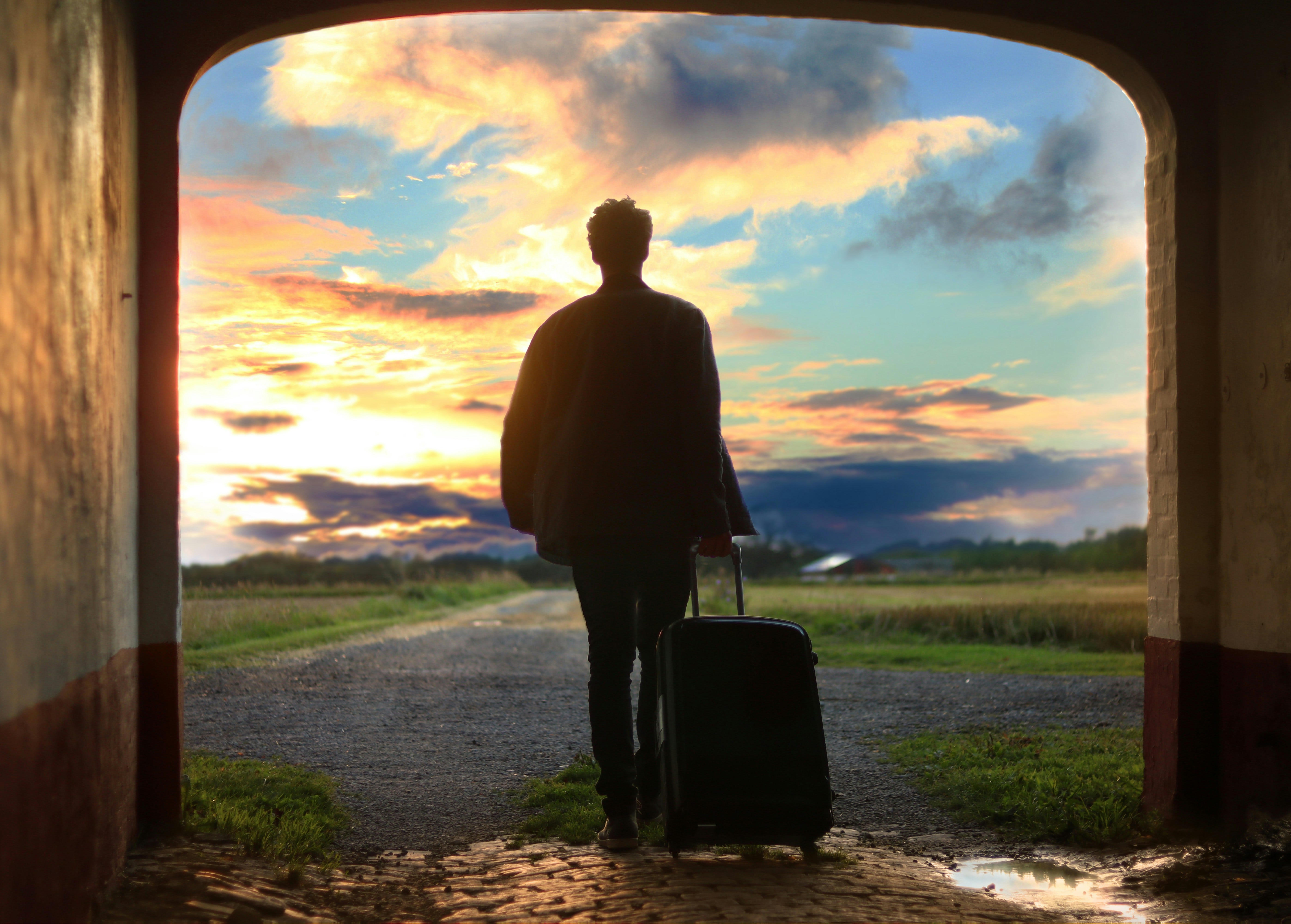
Greetings, fellow wanderers,
Today I am republishing another post from the archives. I want readers to know that I am diligently working on the final revisions for my upcoming book, so I will have a slight lull in the number of new posts for the next few weeks.
Also, as Those Who Wander acquires fresh subscribers, I recognize that many newcomers may not have access to or be familiar with some of my initial writings. With over 100 posts in the archive, I want to expose these paywalled posts to more readers.
If you have been enjoying these ramblings on travel, adventure, and anthropology, please consider supporting my writing, which grants you full access to everything I’ve written on Substack, including excerpts from my upcoming book. In addition, the proceeds will go toward publishing and promoting my forthcoming book, ‘An Anthropology of Wandering: How Adventure Can Alleviate a Fearful Culture’. The book is a first-person account of backpacking the Appalachian Trail that dives into anthropology, travel, fear, and the meaning of adventure in culture and society. If you love social science, adventure, and travel, this book will be for you. Subscribe and stay tuned for more updates.
Can’t subscribe right now, but want to do a one-time donation? Buy me a coffee!
Thank you to everyone who has subscribed and supported my work thus far.
Cheers!
-JSB
Now onto today’s archived post, On Leaving and Returning: The Peculiarities of Traveling
As travelers, we are perpetual motion machines, in a constant state of flux between leaving and returning. From a bird’s eye view, it appears as though we cannot make up our minds on where to stay, always frantically moving to and fro. An objective observer of this strange and amusing behavior of ours might be forgiven for thinking all human travel is little more than a transitional process of leaving and returning. Precisely when, they might ask, have you arrived and are no longer leaving or returning?
We may spend days, weeks, or even months planning for an upcoming trip. We attempt to meticulously calculate all the essentials we’ll need to pack. But are we, in some sense, already in a state of “leaving” at this point when our minds attempt to envision our imminent future? When exactly do we “leave” for our travels? Is it when the foot breaches the threshold of our home or when we exit our county of residence or the city limits? Perhaps it is when the wheels of the aircraft lift off the runway.
When we pay close enough attention to how we travel and the things we do and say while traveling, we realize much of our mental and physical energy is entirely consumed by these two aspects of travel. Is this ultimately what traveling is—a long course of leavings and returnings? Why is it so bothersome to some of us to describe it that way?
On a recent trip to Tucson, Arizona, for a wonderful wedding in the Sonoran Desert, followed by a vacation in O’ahu, Hawai’i, I tried to study this phenomenon of leaving and returning. As we approached the airport, we came to a fork in the road with two signs and two arrows that many of us rarely give a second thought to—arrivals and departures. Airports fill many of us with anxiety and frustration as we attempt to make it through security checkpoints and get to our gates on time. At best, the experience is one of boredom. Once fastened into our seatbelts and listening to the safety message we’ve all heard a hundred times, we do all we can to get through this trivial part of our trip, filling our time with watching shows on our iPads, playing games on our phones, listening to a podcast, reading, downing an Ambien with a cocktail, and sleeping. Throughout our trip, I did my best to focus on these more mundane aspects of traveling.
Although at first glance, these bookends to our travels might not be the most interesting parts of our sojourn, they surprisingly turn out to be a rather interesting philosophical exercise—is the act of traveling little more than an entire series of what we might label as “leavings” and “returnings”? Where are those fond moments of adventure to be found when we relay our travels to others later down the road? Are the memories of our “adventures” and travels partly a construction of our imaginations—one where we highlight the dramatic or romantic parts while downplaying or leaving out the mundane and monotonous?
In the study of philosophy, arrivals and departures fall into what are categorized as events or “happenings”—these moments that occur or “things that happen” in life are distinguished from physical objects like coffee tables and books, and other mental phenomena such as facts or thoughts. What is perplexing about events is that it isn’t fully clear where the boundaries of such events are. For instance, when you go for a walk, can you spatially determine where the moment your walk “begins” and “ends”? Does it technically begin in the head when the thought “I’d like to go for a walk” arises in your mind and ends the moment you consciously transition to your next chosen activity, say cooking, when the thought of hunger arises in the stomach and percolates into consciousness?
Throughout our travels, I noted how our entire trip was inundated with a constant series of smaller leavings and returnings. While I sat meditatively on the plane at 30,000 feet listening to podcasts, watching people snooze and scurry to the bathroom, and assisting our son Walden with his games, I surprised myself by actually enjoying a plane ride for the first time. I wasn’t anxious to get anywhere and genuinely took an interest in this shared act of leaving, and it dawned on me that leaving and returning are pretty much what travel is. And I became fine with that realization.
One can’t help describing the narrative of one’s trip this way: After the wheels of the airplane came to a halt, we made our way through the bustling Phoenix airport to our rental car, thus leaving our initial destination behind. The following morning, we awoke all too early with our tired and understandably cranky toddler to leave the hotel toward our next destination in Tucson, momentarily stopping at the Children’s Museum before leaving to find ourselves in a beautiful Sonoran Desert ranch that would serve as the wedding venue.
Here we met our family, and the great wedding festivities unfolded before us. We caught up with those we hadn’t seen in a while. Trying to stay mindful of my travel topic of leaving and returning, I noted some of the initial conversations we were having. Our language is a curious window into the human mind. We broke down our “leavings” to one another by sharing how our flights were, whether we left any essential items behind, and what time we arrived at the airport, hotel, or ranch.
Even more amusing, at the end of this wonderful weekend in the desert, everyone would recreate this shared ritual exchange of their soon-to-be travels by discussing their return. When would we be leaving tomorrow? Will you be returning home or leaving for another destination? There is a wonderful structure and order to everything we do. As an anthropologist, it is intriguing how much ritual is unconsciously embedded in everything we do and how we seamlessly piece our personal narratives together this way.
Lucky for us, we were now leaving for O’ahu for our family vacation, but not before first returning to our hotel in Phoenix to depart the following day for Honolulu. Our vacation, much to our surprise, traveling with our toddler in tow and crossing several time zones, went incredibly well. We wandered across much of the small tropical island, leaving and returning to and from our hotel in pendulum-like fashion to the museum, to parks, to hikes, to breakfasts, lunches, and dinners along the beach, swimming and watching sunsets and sunrises—and all these activities in the most wonderful, paradisiacal tropical temperatures you could imagine.
Now that we had been here for a while and we were reaching the end of our vacation time, we were no longer in the phase of leaving for our travels but were now in a state of returning home. The packing and planning had begun. At the end of leaving on all our journeys, there comes a moment when we cast our gaze back toward home and begin returning. And so, we did.
I recalled something else peculiar about traveling during our trip that I noted years ago while backpacking the Appalachian Trail: how we imbue unexplored places of the world with romance and wanderlust. Something interesting happens once we’ve arrived, settled, and been in these distinct places for a prolonged period: the mysterious mist of romantic allure that originally ensnared us to travel to these places lifts and fades. We come to find that the mist was never there at all, that these places we infuse with fairytale expectations and deep meaning eventually become another commonplace experience and a place we now understand a little better.
It is interesting how we then shift our gaze back toward home or another far-off place and allow the same romanticizing phenomenon to begin anew, urging us to keep moving, to keep wondering and wandering—what is that feeling and why do we do it? This is what it means to have wanderlust, a craving to put the world together in our minds, coalescing like a puzzle.
In a small way, these chosen destinations become an embedded feature of our identities as travelers. They become baked into our minds as memories that we may embellish to hype up our adventures over time. This lends some light to the questions I posed at the beginning. Yes, most of us probably do romanticize our travels to some extent both before and after the fact. Still, it is with good reason, for we do not want it to appear like all we are doing is leaving and returning—frenetically jumping from point A to point B. But what if that is all there is to travel? Might that be okay?
I had originally thought these acts of departing and arriving were boring bookends to our travels—our adventures beginning and ending with the liftoff of wheels on the runway or the locking of a door to our home and heading off to the airport. Traveling, it turns out, is a grand process of leavings and returnings—a progression of constant movement not unlike trying to pin down where the river begins or ends, whether it’s at the top of the mountain, in the gushing stream, the ocean, or the clouds—there is no beginning or end. Like much of life, it is a process. These are artificial constructs our minds impose on the world so we can make better sense of our personal narratives.
To reiterate what I wrote in a previous post, Adventure as a Mindset,
Many of us conceive of adventure as something exotic or foreign, distant, and often expensive, and something “out there,” far away that we do only on occasion. We think of it as a thing, “I’m going on an adventure.” We carve out specific segments of our lives into categories of “adventure” and “not adventure.”... I do not believe this is a useful way to view adventure and argue that we should view it more in terms of a mindset, perspective, philosophy of life, or form of experiencing… Adventure is thus a process or a mindset and a way for us to envision our world and our place in it—as active agents seeking to cultivate a more adventurous worldview.
Whether we are traveling far from home or going to pick up our child from daycare down the road, all any of us are doing is leaving or returning. And that is perfectly fine. In this philosophical sense, travel is not a difference in kind but of degree or distance. We are just moving and wandering through life, and all we need to do is enjoy the ride while we’re here.
If you valued this article or a previous one and want to say thanks, you can buy me a coffee at whatever amount you prefer. Think of it as a tip! :)
Thanks for being a fellow traveler with me through this read. Please consider subscribing, sharing, and supporting this project—much more to follow.
Cheers!
-JSB
I love when writers reframe something so common we take it for granted. Justin S. Bailey’s On Leaving and Returning reframes travel not as a string of exotic highlights but as a rhythm of thresholds—packing, airports, hotel checkouts, and the quiet rituals of departure and return. Through a philosophical and anthropological lens, he suggests that what we call “travel” is really a continuous state of motion, dissolving the line between adventure and everyday life. Travel, like existence itself, is process, not punctuation—a mindset rather than a map.
There’s something beautifully humbling in that idea: seeing travel not as escape but as a mirror of how we live every day—always between thresholds, always becoming. Leaving and returning aren’t opposites; they’re the same breath, drawn in and released across continents or across the street. ✈️🌍
I enjoyed listening to this a second time. My husband and I have lists we go down every time we get ready to travel so that we try not to forget anything while packing. Perhaps for us the packing and checking off items on the list is the beginning of our going away.