

The Future Depends on Reimagining Our Lives Now: Where is Society Going in the Wake of AI Hype and Transformation?
How we think and act in the world today sets in motion the world of tomorrow. What kind of future do we want to wander in?

My book An Anthropology of Wandering: How Adventure Can Alleviate a Fearful Culture is now available!
Read more about it here and enjoy an excerpt from the book here.
Now until June 7, receive 30% off your subscription, plus 35% off my new book ($19.99, $12.99). (A link to the discounted book purchase will be sent to your email upon your paid subscription to Those Who Wander).
To learn more about the book, please visit here, and you can listen to my latest conversation about the book on a podcast with the New Books Network here and on Spotify:
“One thing that seems especially striking in contemporary culture is how few benign visions of the immediate future are offered up. The mass media show all sorts of apocalyptic scenarios, ghastly futures. And there tends to be a kind of self-fulfilling prophecy to these prognostications. How rarely is it that we see a projection twenty or fifty, or a hundred years into the future, into a world in which we have come to our senses, in which we have figured things out? We can do that. There’s nothing that says that we will inevitably fail to meet these challenges. We have solved more difficult problems, and many times.”
- Carl Sagan, The Varieties of the Scientific Experience
Anthropologists have spent generations debating what culture is and how we change it. Though we can largely agree upon some broad definition of culture by now, many have concluded that it is a fool’s errand or even hubristic to think we have the power to change culture and society at any meaningful scale. Nearly all the major changes that have occurred in history were completely unpredictable after all.
Anyone who’s spent a lot of time thinking of all the factors that influence human behavior and cultures knows that we are embedded in “webs of meaning” as Clifford Geertz once famously observed. And yet, a part of me still believes optimistically (or perhaps naively) that if one can change the habits, values, and goals of enough people, one can gradually change culture. But a critical mass has to be reached for enough change to gain that kind of momentum. Enough of us have to be on the same page with where we want society to go in the first place.
In previous posts, I’ve highlighted what I think would make for a better, more mindful society, one in which we’ve learned to slow down and one where I envision more of us experiencing the freedom to explore it. However, the freedom to slow down and explore is dependent on the kind of world we are creating right now in how we think, act, and educate one another. As I remarked in What Does the Future of Travel and Adventure Look Like?,
Each of us who aspires to live in a world that we can see and experience more often has some duty to work on a project in the here and now that enables that world to come into existence.
With all the current hype about the artificial intelligence revolution replacing jobs, enacting universal basic income, and general debates about what jobs humans are going to be doing for the rest of this century (and for all time), it opens up a much broader discussion on the meaning of our lives and potential opportunities to shift our minds in new directions. What new possibilities are ahead of us? Are we prepared for the kind of transformation everyone seems to think we’re about to witness?
Undoubtedly, there will be something we classify as “work” for the foreseeable future, but it could look very different from what we consider work today or even a century ago. Many of the most labor-intensive jobs are done almost entirely by machines these days, unlike in the preindustrial world, when everything was done by human backs and hands and often alongside domesticated animals serving as our “beasts of burden.” It could be that, very soon, we will be entirely unburdened from most lines of work. Hard to fathom, yes. But worth taking seriously.
Even the most optimistic outcomes of the near future leave much uncertainty before us. What will this mean if most or all of humanity one day has such an abundance of liberty and unlimited leisure time? Some of us seem incredibly bothered by the notion that we’ll be out of work. Immediate mass unemployment doesn’t sound good. And after all, many derive a great deal of meaning from their work, and it does become hard to imagine how our entire economic system would even function. However, assuming all our wants and needs can somehow be magically met, I do not know why this is necessarily a cause for alarm in the long run.
To my mind, most of us come to loathe our jobs at some point and have always been “working for the weekend,” whether we wish to admit that or not (for good measure, forget to mention that in your next job evaluation). The vast majority of jobs are not ones most of us, I suspect, would do without the incentives of pay or benefits to sustain our lifestyles. Though I can understand there are occasional jobs that do satisfy the urge for meaning and purpose in one’s life, I can’t help but think that most of us would quickly transcend this idea once we’ve been exposed to all the possibilities that would open up, provided unlimited free time and an abundance of resources.
Think of this scenario as only applied to our personal lives for a moment. Are we truly so unimaginative that we couldn’t think of how to fill our 40+ hour workweek with other favorable and productive activities? One would presume we wish to spend more time with friends and family, or cultivate our hobbies, improve our education, or read books we’ve never had time for, or travel and have all those adventures we dreamed of partaking in one day.
There is something cynical about assuming many of us would just sit around and do nothing without the sticks and carrots of our society pressuring us to earn our bread by the sweat of our brow. Woodworking, gardening, fishing, hunting, gathering firewood, and learning a language or two are just a few things I’d love to do more of, and of course, travel much more! Some, if not all, of those activities certainly involve a lot of sweating, and I suspect many out there would also find these activities and more highly fulfilling in the absence of routine work and other money-gathering exercises. Can we not reimagine a world beyond the current economic, political, and social structure we currently inhabit?
I think we can.
The fundamental prerequisites of any advanced human society with billions of us scattered across the globe largely depend on energy and technology to produce an abundance of food, water, and other resources. Additionally, we obviously also need systems of health, medicine, and domestic and foreign security in place to prevent disease, famine, and outbreaks of violence so that we have the opportunities to reach our full potential and can partake in all the things we ultimately find meaningful—the peak of self-actualization is Maslow’s hierarchy of needs.
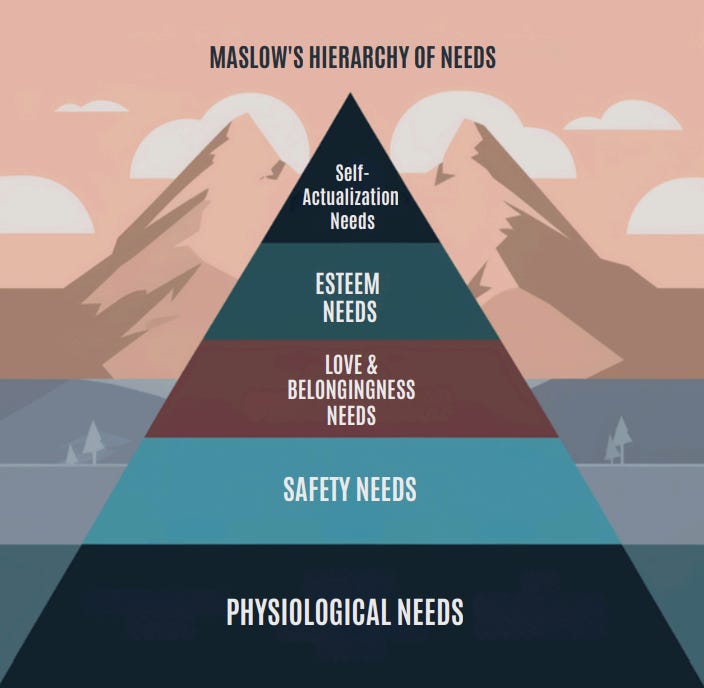
Until we’ve fully figured out how to adequately satisfy these underlying needs of society, we will never be able to transcend to a truly prosperous and liberated world.
And we should bear in mind that this reimagined society will not be a utopia, just a future state that has figured out how to properly utilize the human knowledge that already exists. By this, I mean that there is little new knowledge yet to discover as far as human well-being is concerned, i.e., the conditions for what makes humans live long, healthy, and meaningful lives. This isn’t a mystery. Millions of us have known how to do this for centuries.
Our main problem in a global society is figuring out how to distribute and allocate resources fairly and conveniently to more people, and utilize knowledge in ways that allow everyone the opportunity to seek and obtain a flourishing life. In some sense, I think we all know what our equation is to the good life. Putting it together is the hard part.
We must first imagine different models for how society can operate and allow more time, incentives, and finances for the things that truly benefit our well-being, like I suspect adventure and travel do. Most of us are prohibited from extensive travel and adventure today, mainly because it is often too costly in both money and time. If the parts of the AI hype that are optimistic turn out to be true—where we are granted an abundance of time and resources to truly do what we all deep down want to do with our single life on this planet—then what will hold us back from “seeing the world” as so many of us have claimed we want to do?
I’ve argued in my recently published book An Anthropology of Wandering that, as a species, we humans are inherently curious to explore our world. What holds us back the most is the present structure of society. While, historically speaking, society is in a far better state, arguably better than it’s ever been, it still manages to keep most of us largely sedentary, bound to jobs most of us do not like, and wishing for an alternative to life where we do not spend the bulk of our time, attention, and money merely “getting by” or living “paycheck to paycheck” but ascending to our full potential.
The writer and speaker Alan Watts once famously asked us to meditate on this valuable question: “What if money were no object?”
How might we learn to reimagine living our lives?
The ensuing artificial intelligence revolution may soon force us all to truly confront and grapple with what a world will be like without money dictating so much of our decisions and behaviors. When one begins to think about it, it is quite extraordinary how much of our lives is ruled by money. Can we actually envision living a life where money and jobs become obsolete? What would your day look like? What would the rest of society look like if we all simultaneously won the lottery in this way? That may essentially be what happens in our lifetime.
While I am skeptical of a lot of the AI hype about ushering in a complete utopia, I remain hopeful that it will at least cause many of us to reorient our thinking about the meaning of our lives. If the day ever comes when our lives are radically transformed, and we are all basically permanently retired while all the machines take care of all the mundane work, we’ll then be left in a phase of humanity with many scratching their heads, bewildered about how to now spend our time. I don’t know if we’re quite ready for that dramatic a change, but I do know humans are resilient and adaptable, and we can figure things out as we’ve done many times before.
There is still a great need right now to plan wisely for what is coming and to do our best to navigate the unknown. It turns out, this is how it’s always been for humans throughout history—staring the future in the face, unsettled by what may come. And it will remain this way regardless of whether or not the AI revolution causes money, jobs, and all our worries to vanish overnight, because we will still be left with the fundamental problem of learning how to find our meaning and lead a satisfying life. No machine is going to figure that out for us.
Let us not lose sight of the fact that we must remain mindful of how we spend our time and attention, right now. How we think and act in the world today sets in motion the world of tomorrow. So what kind of future do we want to wander in?
Related articles:
The Case for Slow Travel and Slow Reading in a Fast-Paced Society
How Travel and Adventure Factor into an Equation of the Good Life
The Hope of Travel, Part II: Does Travel Have the Power to Piece the World Together?
My book An Anthropology of Wandering: How Adventure Can Alleviate a Fearful Culture is now available!
Read more about it here and enjoy an excerpt from the book here.
Thanks for being a fellow traveler with me through this read. Please consider subscribing, sharing, and supporting this project—much more to follow.
Cheers!
-JSB